
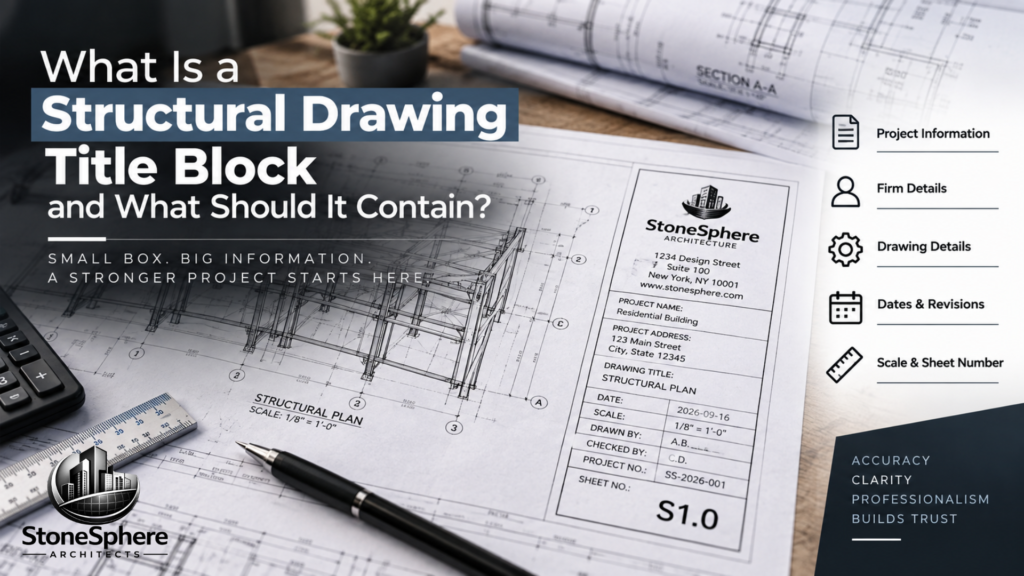
Pulling up an old sheet with no revision date, no engineer’s stamp, and no clear project reference is a small headache that can turn into a real liability once construction is already underway. Without this basic information, nobody on-site can confirm they’re working from the correct, current version of a drawing. The fix is simple: every sheet needs a complete structural drawing title block containing the project details, revision history, and approval information reviewers and contractors depend on. This article explains what belongs in this block, where it’s located, and why getting it right matters more than most people realize.
What Is a Structural Drawing Title Block?
This bordered, standardized section on a drawing sheet holds identifying and reference information about that specific drawing. It’s typically positioned in the lower right corner of the sheet, following conventions used across engineering disciplines worldwide.
Rather than decoration, this block functions as metadata that makes the drawing usable and traceable. Anyone picking up a single sheet, separated from the rest of the set, should be able to identify the project, the drawing’s purpose, and its current revision just from this one section.
Core Elements Every Title Block Should Include
Most complete blocks follow a fairly consistent pattern, though exact fields vary somewhat by firm and jurisdiction. A thorough structural drawing title block typically contains:
- Project name and address – identifying the specific building or site
- Sheet title and number – describing the content and its place in the set
- Drawing scale – critical for interpreting dimensions correctly
- Date of issue – confirming when the sheet was completed or last revised
- Drafter and engineer names – for accountability and traceability
- Firm name, address, and logo – identifying the responsible organization
Leaving out any of these fields makes a sheet harder to trace back to its source if questions come up later.
Read Also: Structural Drawing Scales: How to Choose the Right Scale for Construction Documents
Engineer’s Stamp and Licensing Information
Structural drawings carry an added layer of legal weight compared to many other technical documents, since they often require a licensed engineer’s seal. This stamp, along with a license number, typically sits near or within the title block area.
Building departments specifically check for this information during permit review, and its absence is one of the more common reasons structural submissions get flagged. Keeping a dedicated, clearly marked space for the stamp avoids confusion about whether a sheet has been properly reviewed and approved.
Revision Tracking Within the Title Block
Revision history is one of the most important functions a structural drawing title block serves, since construction projects rarely stay static from first draft to final approval. Most blocks include a small table listing:
- Revision number or letter
- Date of each revision
- Brief description of what changed
- Initials or approval of who authorized the update
This table lets anyone glance at a single sheet and immediately understand its revision status, without needing to compare it against older versions stored elsewhere.
Read Also: Structural Drawing Revisions Management: Best Practices for Construction Teams
Regional Standards That Shape Title Block Format
Title block requirements aren’t entirely universal, and firms working across different regions need to account for this. In North America, the ASME Y14 series governs sheet sizes and drawing practices, while ISO 7200 serves as the international standard used across much of Europe and beyond.
These standards influence details like unit systems, projection methods, and even how much legal or contractual language appears alongside the standard identifying information. Firms working on multinational projects often maintain separate title block templates to stay compliant in each region.
Digital File Naming and the Title Block
As more firms move to digital drawing management, the information in a title block often gets mirrored in the digital file name itself. Consistent naming conventions that reference the sheet number, revision, and date help keep electronic files organized in a way that matches the printed set exactly.
This becomes especially useful once a project moves through several rounds of review, since anyone searching a shared folder can quickly confirm they’re opening the correct, current version.
Why Consistency Across a Set Matters
Beyond individual sheets, keeping title block formatting consistent across an entire drawing set makes the whole package easier to navigate. A reviewer flipping through dozens of sheets benefits enormously when every title block sits in the same location, uses the same fonts, and lists information in the same order.
Inconsistent formatting between sheets, even when all the required information is technically present, slows down review and increases the chance something gets overlooked. Using a shared template across the entire office, rather than letting individual drafters build their own, is the simplest way to avoid this problem.
Read Also: What Is a Structural Drawing Set and How Is It Organized?
Common Mistakes in Title Block Preparation
A handful of avoidable issues show up repeatedly across poorly prepared sheets. Watch for these before finalizing a drawing set:
- Missing or outdated revision entries that don’t match the actual sheet content
- Incomplete stamp information on projects requiring a licensed seal
- Inconsistent formatting across different sheets in the same set
- Generic sheet titles that don’t clearly describe the drawing’s actual content
Final Thoughts
A complete structural drawing title block does far more than fill space in the corner of a sheet; it provides the traceability, accountability, and revision history a project depends on from design through construction. Making sure every field is filled out correctly, consistently, and in line with applicable standards keeps your drawing set organized and protects everyone involved if questions ever come up down the road.